
Step 5 Preview spreads to OpenCode after its OpenRouter debut
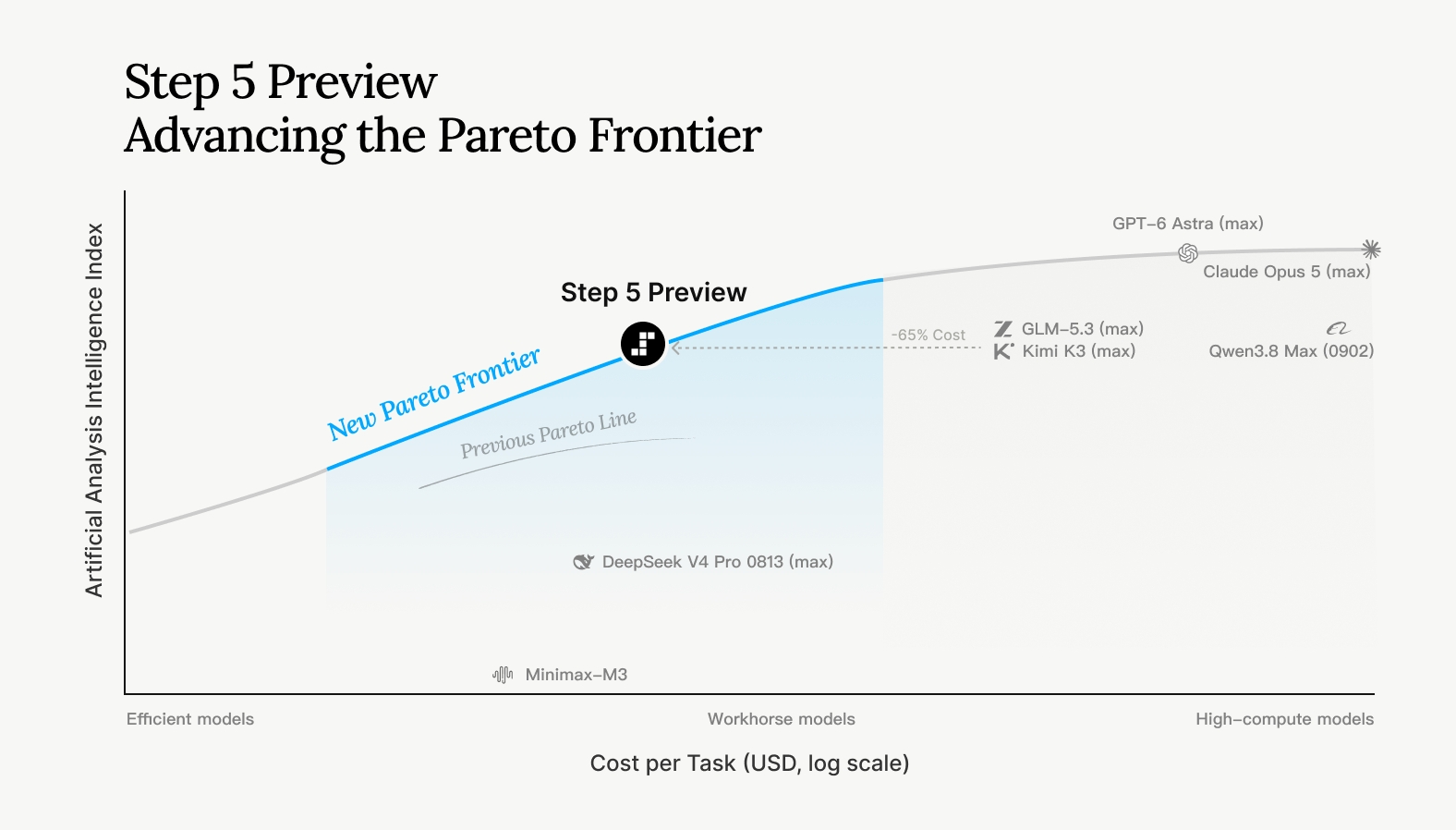
Step 5 Preview is now listed on OpenRouter, OpenCode Zen and OpenCode Go. The route additions expose a one-million-token context window, multimodal input and a 64K maximum output, while the Zen listing carries a temporary free-window flag.
AI Neural Narration
48kHz StudioFish Audio Neural Engine · Natural editorial narration
| Platform | Route Identifier | Context | Max Output | Rate / Tier | Status |
|---|---|---|---|---|---|
| OpenRouter | stepfun/step-5-preview | 1M tokens (1,000,000) | 64K tokens (64,000) | $1.00 input / $2.70 output per 1M tokens; $0.05 per 1M cached input tokens | preview |
| OpenCode Zen | step-5-preview-free | 1M tokens (1,000,000) | 64K tokens (64,000) | Temporary free-window offer recorded by AIMI; availability can change | free |
| OpenCode Go | step-5-preview-free | — | — | OpenCode Go route; pricing and subscription coverage are not classified by AIMI | active |
Key Takeaways
- check_circleStepFun’s official page describes Step 5 Preview as its flagship model for agentic work, but this article covers gateway availability rather than a new same-day maker launch.
- check_circleAIMI first saw the OpenRouter route at 14:53:14 SAST, then the OpenCode Zen and Go routes at 15:57:14 SAST, exactly 1 hour and 4 minutes later.
- check_circleThe verified model profile accepts text, images and video, with a 1,000,000-token context window and 64,000 maximum output tokens.
- check_circleOpenCode Zen carries a temporary free-window flag. OpenCode Go is a separate route with unclassified pricing in AIMI, so the two products should not be merged.
- check_circleStepFun says open weights are planned for 15 October. They are not part of the currently verified serving routes.
One model, three gateway routes
The useful event here is a serving-route wave. AIMI first recorded StepFun’s Step 5 Preview on OpenRouter at 14:53:14 SAST on 8 October. It then saw step-5-preview-free appear on both OpenCode Zen and OpenCode Go at 15:57:14 SAST, exactly 1 hour and 4 minutes later.
The identifiers should not be counted as three model launches. OpenRouter uses stepfun/step-5-preview, while OpenCode exposes step-5-preview-free. The maker page and the model profile identify the same Step 5 Preview family, and the route differences belong to the gateways.
What StepFun says about the model
StepFun describes Step 5 Preview as a flagship model for agentic work, software engineering, professional knowledge work and finance. It uses a sparse Mixture-of-Experts design with 600 billion total parameters and 27 billion active per token.
The official documentation lists a one-million-token context window, text, image and video input, text output, tool calling, JSON mode and JSON Schema support. It also lists reasoning effort settings of low, medium and high. Those are model-level claims, so the active gateway should still be checked before relying on each feature.
Route pricing is not interchangeable
OpenRouter lists $1.00 per million input tokens, $2.70 per million output tokens and $0.05 per million cached input tokens. AIMI records reasoning, tools, function calling and structured outputs on that route.
OpenCode Zen is a separate gateway. AIMI marks its step-5-preview-free identifier with a temporary free-window offer. OpenCode Go is a separate subscription product, and AIMI does not classify the pricing or entitlement for this route. Treating both as permanently free would be wrong.
The dates that matter
StepFun’s page says the hosted model is available through its products and API, and that open weights are planned for 15 October. The page does not establish a new StepFun announcement on 8 October. The same-day event verified here is gateway availability.
The OpenRouter route appeared 14 hours, 25 minutes and 31 seconds after AIMI first saw the earlier Claude Haiku 5.5 routes at 00:27:43 SAST. OpenCode’s routes followed 1 hour and 4 minutes after OpenRouter. These timestamps describe availability observations, not a response by one company to another.
A practical way to test it
Check the relevant live models endpoint immediately before configuring a client. Use OpenRouter for the documented paid route, OpenCode Zen for the temporary free-window listing, and OpenCode Go only under its own subscription terms.
For a production workflow, keep the exact provider and model identifier in your configuration and test the features you need. AZ Labs customers can use the AI Gateway to keep provider changes outside application code while comparing quality, limits and cost.
Frequently Asked Questions
Is this a new StepFun launch on 8 October?
The verified event is a gateway availability wave. StepFun’s official page describes the model and its hosted availability, while AIMI recorded new OpenRouter and OpenCode routes on 8 October.
Which routes does AIMI verify?
AIMI verifies openrouter/stepfun/step-5-preview, opencode-zen/step-5-preview-free and opencode-go/step-5-preview-free. They are serving routes for the Step 5 Preview family, with different provider terms.
Is the OpenCode route free?
AIMI marks the OpenCode Zen route as a temporary free window. OpenCode Go is a separate subscription gateway with unclassified pricing in AIMI. Check the live provider terms before relying on either route.
What is the verified context window?
The AIMI profile and StepFun documentation list a 1,000,000-token context window and a 64,000-token maximum output. Provider-specific limits can differ.
Are the open weights available now?
No. StepFun says the open-weight release is planned for 15 October 2026. The routes covered here are hosted serving endpoints.
Related Frontier Models & Releases
Explore verified specifications, benchmark results, and route pricing across alternative models in this class.
Alibaba Qwen Releases Qwen3.8 Max: 2.4-Trillion Parameter Flagship with 1M Multimodal Context
Alibaba's Qwen team has launched Qwen3.8 Max, a 2.4T parameter Mixture-of-Experts model offering 1M token context, native video perception, and deep agent tool orchestration.
Meta Releases Muse Spark 1.3: 1M Multimodal Reasoning Model for Autonomous Agent Workflows
Meta Superintelligence Labs has published Muse Spark 1.3, an open-weights frontier agent model with 1,048,576 context tokens and comprehensive multimodal comprehension.
Google releases Gemini 3.8 Flash for long-horizon coding
Google has released Gemini 3.8 Flash as a generally available model for long-horizon coding, autonomous agents and enterprise workflows. The API keeps the introductory price of Gemini 3.7 Flash, with a one-million-token input limit and 65,536-token output limit.
From news to working software
Want AI like this doing real work in your business?
We track these releases so our clients do not have to, then build voice agents, WhatsApp assistants and automation on the models that suit the job. Written price in rand before any work starts.